The types of assets that are left to children, your spouse or a trust are all important from a tax standpoint.
Qualified Retirement Accounts
Leaving your qualified retirement accounts to your spouse outright will create the optimal tax benefits. These include IRAs, 401ks, 403bs, 457bs, TSPs etc.
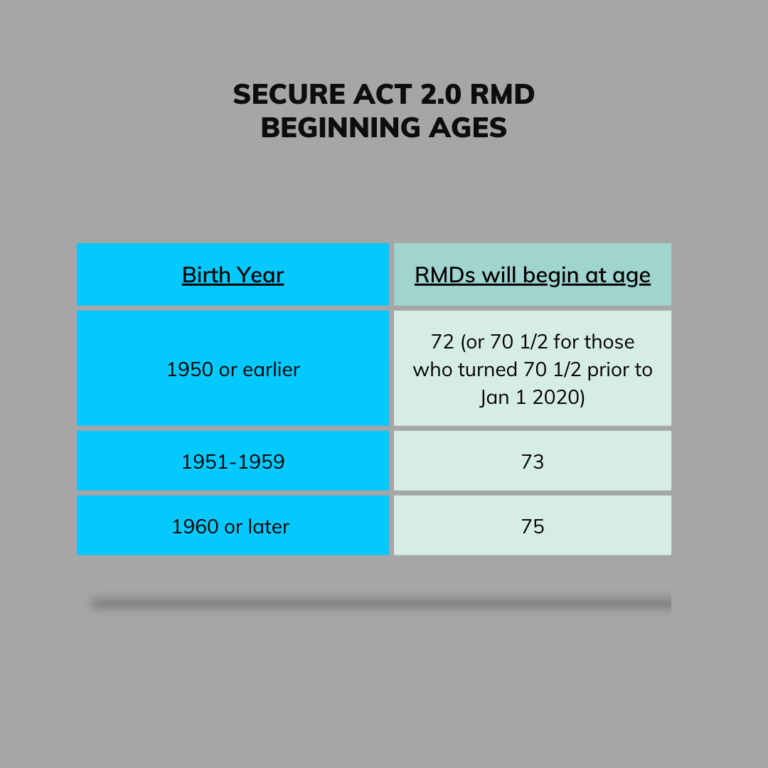
On the other hand, leaving qualified assets to your children will likely trigger the new 10-year rule. With the SECURE Act coming into effect in 2019, these accounts can no longer be stretched according to the child’s life expectancy. This will likely result in an acceleration of taxes that could have been minimized had these accounts been left to a spouse.
Naming a trust as beneficiary of a qualified plan also presents some challenges. Tax brackets are significantly higher for trusts versus an individual.
In 2022, a Married Filing Joint taxpayer would have to earn over $647,850 in taxable income to cross the highest tax bracket at 37%.
For trusts, the highest tax bracket threshold is only $13,450!
If you name a trust as beneficiary of a retirement plan, make sure your attorney has revised or drafted the documents to align with the SECURE Act rules. This could mitigate unnecessary tax implications.
Taxable Investments
Investments including stocks, bonds, mutual funds, ETFs, real estate, tangible property and even crypto assets would fall under this category. This assumes these investments are held outside of an IRA, 401k or other qualified retirement plan.
The major tax benefit for these assets is the step up in cost basis after death.
How does the step up in cost basis rule work?
Let’s say you bought $100k of Apple in 2000 and it’s now worth $500k. If you sold $500k worth of Apple, your capital gain would be $400k (500k – 100k).
If you die before selling it, your beneficiary gets a “step up in the cost basis.” Instead of your beneficiary paying taxes on the gain of $400k, their new cost basis is now $500k. If they sold the stock immediately thereafter, they would have little to no capital gains taxes due!
For married couples, there are some additional rules that are based upon the state you live in. For community property states, assets are assumed to be owned jointly, and therefore only ½ of the basis is assumed to be stepped up upon the death of the first owner. Upon the death of the second owner, than the full step up rule is applied.
In non-community property states, you could in fact own assets separately from your spouse so they can take advantage of the FULL step up at your death. This could be accomplished with a revocable living trust in your name only, OR perhaps individual ownership with your spouse as beneficiary (via TOD or POD designations).
Make sure you consider your estate planning and wealth transfer goals before making any changes to your asset titling!
Life Insurance
We’ve already discussed the functionality of leveraging life insurance to take care of one or more of your wealth transfer objectives.
From a tax standpoint, this is one of the most tax efficient assets to leave a beneficiary. It’s 100% income tax free and probate free! Additionally, you can structure this strategy to pass outside of your estate by way of an Irrevocable Life Insurance Trust (ILIT).
If you have a beneficiary with special needs, you could also fund their “Special Needs Trust” with life insurance.